A Moment Can Change Everything

How meeting a dead saint rocked my world... and finally found me a publisher
It only took a moment, but when it happened, there was no going back.
We know deep in our bones, that life is fragile and everything can change in an instant. That knowledge can make us grateful for the present moment, or terrified we are going to lose it all.
But sometimes, that sudden, earth-moving shift can be a good thing. A really, really good thing.
That’s what happened to me.
It seemed like a random chance. A message on Facebook that I should visit “Eileen’s house” while I was in Sydney, Australia. I’d never heard of her, but I said yes.

The house is a weatherboard house in Coogee, up on a hill overlooking the ocean. The former owner is Eileen O’Connor, an intriguing young woman with an astonishing tale to tell.
Eileen was born into a time when tuberculosis was common, and unfortunately contracted the infection in infancy, which spread from her lungs into her bloodstream, lodging in the bones of her spine where it caused abscesses. Eileen’s spine was deformed and pus pressed on her spinal cord causing partial paralysis. She only grew to be three foot ten tall, and died at the age of twenty-eight.
But, studying the museum cases that filled two rooms in her house, I learned this pain-wracked disabled girl had, by some extraordinary mystery, set up a home nursing organisation from her own sickbed in 1913 to care for the sick in the slums of Sydney through catastrophes such as World War I and the Spanish flu pandemic. I reeled in incomprehension at the seeming impossibility of this undertaking. When I learned that she also weathered persecution from the local Catholic church so bad that she finally got out of bed (after being bed bound for several years) to make the arduous journey to Rome on a troop ship while Europe was at war the seeds of an obsession were planted as I murmured, “How? How on earth did she do that?” under my breath in the museum.
Still bemused, I sat alone in a pew in her former bedroom, which is now a chapel where Eileen is buried under the floor. I ruminated for a while in silence.

Suddenly, the air was electric, my mind became still, and I knew, beyond doubt or reason, with absolute, startling clarity that I was in the presence of a saint. The sensation might have only lasted a moment, but it also might have lasted forever, because the memory is still strong now, eight-odd years later.
Maybe I should have left that hyphen out, because you could argue that the ensuing years could be described as inherently odd. Though I wouldn’t change them for the world, because they changed me to meet the challenges. Falling in love with a dead saint must do that. I use the lower case s as, although many people who knew her in her lifetime thought of her as a saint, and so do several people I know who have met her after her death (me included), Eileen is currently under investigation by the Vatican for official status and needs a couple of verified miracles before it’s official.
Challenge #1. A year or so of wondering at Eileen’s life story, I realised I was being called to write about her. I’ve written novels since I was ten, but none had found a publisher. I researched more, worked with two of the sisters in Eileen’s old community, and wrote and edited a first draft, which the sisters loved.
Challenge #2. Covid. Instead of hoarding toilet paper, I hoarded beads, because - oddly as a non-Catholic - I had developed an obsession with making rosaries. I later realised, Eileen must have caused it, and she had a good reason.
Challenge #3. Cancer diagnosis. Major surgery. Chemotherapy. Fear of mortality. All the things. Hence the rosaries. I joined an online rosary prayer group that Eileen must have known I would need to support me through an utterly miserable time. And not just that, but by the time I had recovered, rewritten the novel, and collected rejections from local publishers, the cofounder of the group (the lovely author Perdita Finn, co-author of The Way of the Rose) had caught the Eileen bug, asked to see the manuscript and recommended me to a publisher she knew would like it.
Challenge #4. While I was awaiting publication, I held fondly onto the delusion that I would be able to promote Eileen’s incredible story at arms’ length, without telling my own story of how a dead saint had impacted my life. As soon as I was published, I learned I was wrong. Every interviewer (at least when you’re an unknown author who doesn’t bring fame or advertising power) needs an angle, and the angle comes from authenticity around how/why the author wrote the book. I had to not only cast aside my delusion, but my aspiration to be a quasi-hermit, and come out of the closet to talk about deeply personal things. The mystical experience of feeling Eileen’s presence. The way she changed from being an object of awed fascination to an attentive support person with whom I could share my deepest fears and burdens while I was sick, whose ever-present example of courage, hope and resiliency in the face of seemingly insurmountable obstacles cheered me on as I limped my way through wretched days. The near death experience I had twenty-five years ago, that I believe triggered my sensitivity to spirituality and somehow made me available to experience Eileen as a living force in my life.

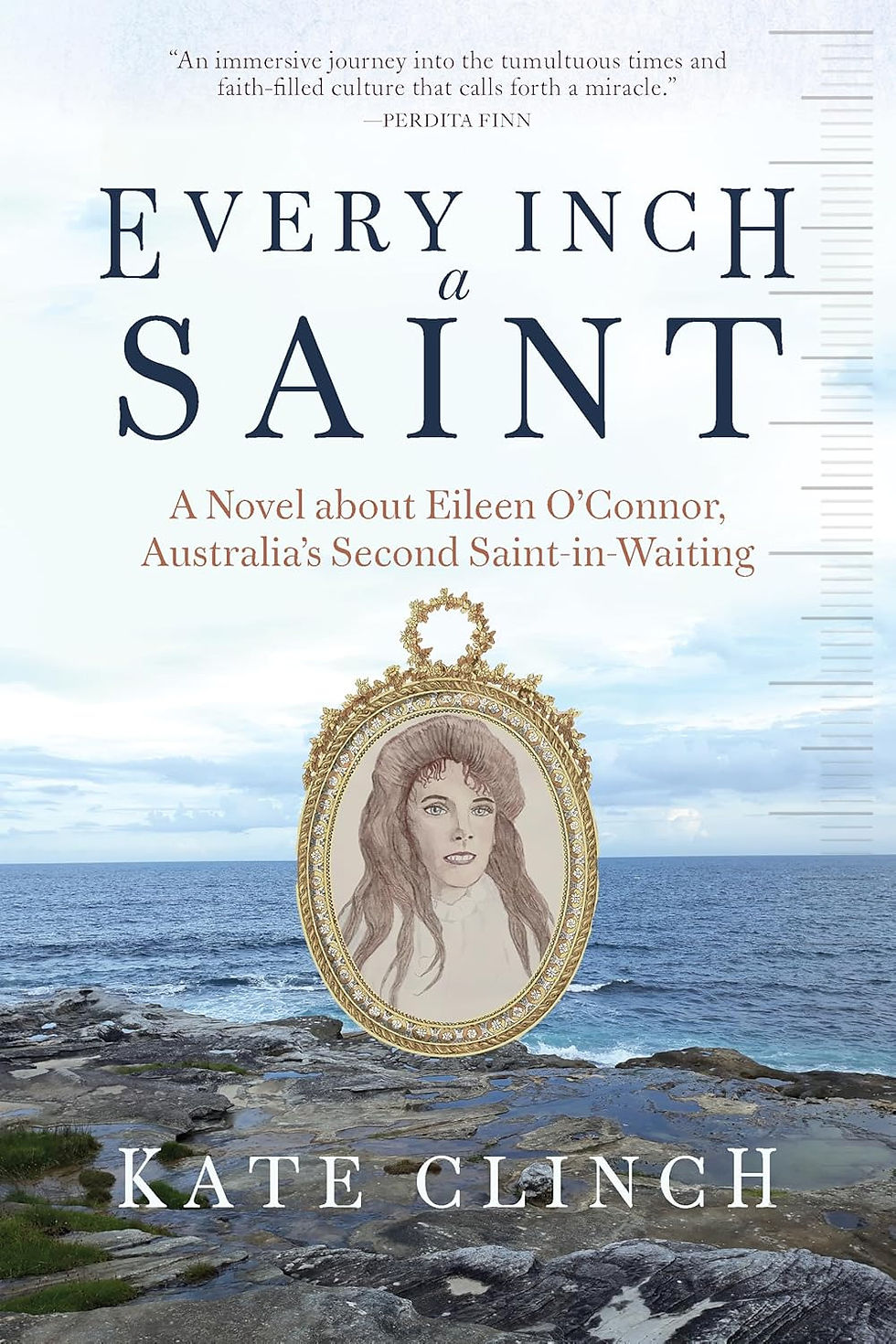
Even, on a lighter note, though still so odd it hasn’t been easy to admit in public, that I had the feeling that Eileen was asking me to paint her picture. Not having ever painted a portrait before, I refused for two solid weeks. Finally I caved in, hearing her say, “Go on, it’ll look good on the cover of the book one day.” I knew trad published authors generally don’t get much say in the cover of their book, but what could I do? I started teaching myself water colour portraiture from YouTube videos. And, in due course, I got an email from my publishers, asking if I had any suggestions for the cover. Listening to those quiet whispers meant I could answer yes.
Challenge #5. Entering the twenty-first century. (Or my kids might say, the twentieth, that’s how behind the times I can seem.) I typed my manuscript on my computer, and could manage google and email. But editing photos, making reels, building a website, all the practicalities of building an online platform - what, you mean I can schedule social media posts? - all news to me. But I’m learning. I made this clip on Canva yesterday. Okay, so I didn’t manage to put music on it, and I might have pulled out some of my hair, but it’s progress and I would never have tried if I hadn’t met an astonishing young woman in a chapel, who broke my heart to let the light in.
Thank goodness for that, because I don’t know how I could have got through my darkest times without her.
She’s catching, too, I’ve seen it happen in people I’ve told about her. Eileen O’Connor is a potent reminder that there’s a mysterious force available to all of us to inexplicably sustain us when life becomes unbearable.
Thank you to those of you who have read Every Inch a Saint and left a review somewhere. If you haven't, leaving reviews on Goodreads and Amazon helps other people find the books you've enjoyed. If you can post a review, I'd be grateful.
If you have caught a dose of Eileen from learning about her, I'd love to hear about your experience.


Comments